
Written by Michael Samjetsabam
Prof. L Lam Khan Piang of Sociology Department of Hyderabad Central University has written an article recently in the Quint titled “Hard Evidence Against Labelling Manipur’s Hill Tribes as Illegal Immigrants.” The article was published on June 7th, 2023.
Prof. L Lam Khan Piang’s Hard Case

In the article, Piang makes an important claim that unprecedented decadal growth rate of ST population seen in erstwhile Senapati district from 2001-20011, which according to him is 241.40 percent, cannot be attributed to Kuki-Zomi majority subdivisions of Senapati district rather it is happening in Naga majority subdivisions of Senapati district.

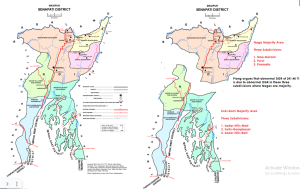
To further appreciate his claim, we can see the map of the administrative divisions of erstwhile Senapati district.

Out of the six subdivisions, three are Naga majority areas and three are Kuki-Zomi majority areas. Naga majority subdivisions are Mao-Maram, Purul, Paomata subdivisions. These subdivisions borders Nagaland. The three Kuki-Zomi majority subdivisions are Sadar Hills West, Saitu-Gamphazol and Sadar Hills East. Furthermore, there is nothing wrong in saying that abnormal growth rate of ST population in Senapati is happening due to the three subdivisions in the Northern Senapati which borders Nagaland.
Comparing Apples and Oranges
At first glance, everything seems fine with Piang’s claim of 241.40 percent decadal growth rate of ST population of erstwhile Senapati from 2001 to 2011. However, if we take a closer look into the DGR data given by Piang in the table below, one unusual issue emerges. Piang, negligently or intentionally, left out a very important caveat about the Senapati Census data of 2001.

2001 ST data for erstwhile Senapati only includes the data of three subdivisions of the erstwhile southern Senapati, namely Sadar Hills West, Saitu-Gamphazol and Sadar Hills East, and not the other three subdivisions in northern Senapati.
The District Census Handbook 2001 of Senapati makes it clear.

In the table 14 of the handbook, ST population of the entire Senapati district in 2001 is entered as 122791. In Piang’s data, the same number is entered in the Quint’s table.
However, there is footnote in the page xiv of the introduction of the handbook that the “following tables” (which includes ST 14 table) do not include the data of three northern subdivisions of erstwhile Senapati as Census data from these subdivisions were rejected for administrative and technical reasons. However, Piang ignores this important caveat.
In his 2011 data, Piang enters the data of total ST population of Senapati from the Census which considers all its six subdivisions. For the table below, see page 25 in Census 2011 Manipur Senapati Handbook.

So, Piang is comparing the 2001 ST population data of 3 subdivisions of Senapati and the 2011 ST population data of 6 subdivisions of Senapati in the Quint table.

So, Piang calculates the DGR of ST population of two different geographical areas by calling them both Senapati without making adjustment in the 2001 data or without making any disclaimer in his Quint article.
These are the two areas which he takes as the same and equal in the above data:

After that, Piang declares that the DGR of ST population of these two different geographical areas as 241.40%. Obviously such crazy figure is going to come up when he has not made any adjustment or made an estimate for what was not counted in 2001 Senapati Census.
And, the Quint did not check the accuracy of the data.
Ignoring Common Knowledge !
It is a common knowledge among the scholars in Piang’s area that in 2001 census data, the three subdivisions, Mao-Maram, Purul and Paomata, in Senapati district are not included.
The Telegraph report titled “Villagers reject fresh census in Manipur,” dated October 20, 2003 writes:
“The provisional report of the 2001 census mentioned an abnormal increase in the population of all three subdivisions.”
“An official source said enumerators met with resistance from villagers while attempting to do a headcount again in Purul, Paomata and Mao-Maram subdivisions. He said: “When the survey team went there, the houses were locked. The few villagers present there refused to say anything.”
“The fresh census in three subdivisions of Manipur’s Naga-dominated Senapati district has turned out to be an exercise in futility with residents refusing to cooperate with the enumerators.”
Furthermore, in July 2nd, 2004, Sangai Express reported that Registrar General of India (Census) has rejected the data of Mao-Maram, Purul and Paomata subdivisions.
Not only these three subdivisions in Manipur bordering Nagaland, the entire Nagaland’s Census Data of 2001 was also rejected owing to abnormal growth rate in Nagaland. In this context, The Hindu in July 12th 2012 reported:
According to Mr. Rio, the actual population of Nagaland in 2001 was six lakh less than the 2001 census figure of 20 lakh. He argued, however, that a recount would not help as there were “warnings from village and district levels that in the review, the population will increase, not decrease.” So, instead of stirring up a hornet’s nest, the Central and State governments adopted a cautious approach. To avoid ethnic conflict, the Centre deferred delimitation to 2031, while the State government rejected the 2001 census and concentrated on conducting the 2011 census properly. The State government canvassed the Opposition, the bureaucracy, and organisations of tribes, village elders, churches, and students to convince the people that a reliable and accurate census was indispensable “for (the) proper planning of development and also establishing political and social harmony.”
It is a well known issue why 2001 ST data of Senapati and entire 2001 Nagaland population in Census saw abnormal growth. It is also common knowledge that given this issue, erstwhile Senapati data does not include the ST population of its 3 northern sub-divisions. How did Piang calculate DGR between the 2001 data and 2011 data of Senapati without making adjustment in the 2001 data or without making any disclaimer? Why compare apples and oranges!
Is this Data Misrepresentation?
Prof. Piang, Department of Sociology, Hyderabad Central University is a reputed academician and has publications in tribal and ethnicity studies. If gross negligence does not seem to be the reason for this blunder, then it will compel us to think that this is a case of intentional misrepresentation of data. I suspect intentional misrepresentation because 241.40 percent DGR of Senapati from 2001 to 2011 ensures that 66.62 percent DGR from 1991 to 2001 of total population of Chandel district, a hill district, looks normal.
Please mind the footnote in the table below.

In the above data of district wise DGR of Manipur, the 2001 population of the three subdivisions of northern Senapati, Mao-Maram, Purul, Paomata, is estimated and added in the whole of 2001 Senapati district data . However, no estimates are available for specific ST population or other related data such as religious community data or mother tongue data for these three subdivisions.
So, I suspect that this can be a case of intentionally misrepresenting the data. But, as he is a fellow brother from North East, I am also inclined to believe that it is negligence but given his stature it is a gross one nevertheless.
Piang’s Another Hard Case
Another problem emerges if we look at Table 1 of his Quint article because Piang knows very well how he is interpreting the data.

Piang is careful here by stating that the figures in the above table are estimates. These estimates in Dun’s Gazetteer Of Manipur are based on the 1881 Census of Manipur.
Using Captain Dun’s data, Piang claims:

Moreover, Piang is correct in saying that the geographical size of Manipur recorded in ethnography of the late 19th century is smaller than the size of Manipur in the early 20th century census data. According to James Johnstone’s 1896 book My Experience in Manipur and the Naga Hills, Manipur consists of 8000 square miles. In Census 1911, another 5000 square miles were added to its geographical area from the area of Manipur given in 1901 Census of Assam.

Another Apples and Oranges
Let us now look into Piang’s claim that the Kuki-Zomi population was 11.48 percent in 1886.

Piang’s data is accurate. But, a problem emerges if we look at the category Kuki in Dun’s classification. For Dun, Kuki includes many tribes which are clubbed into two subcategories, New Kuki/ Khongjai and Old Kuki.
Dun’s classification:

(See page 25, 32 and 33 of Dun’s Gazetteer Of Manipur.)
The Old Kuki subcategory includes Kom, Anal, Namfau, Chiru, Koireng, Chothe, Purum, Mantak and Hiroi or Lamgang tribes. However, these tribes are not included in the contemporary Kuki nomenclature, they are now known as Intermediate Tribes.
See the contemporary nomenclature in Zou’s 2018 (33) paper:

See Zehol (1998,37).
So, Piang in his data of the Kuki-Zomi population of 1886 combined New Kuki (now known as Kuki Zomi) and Old Kuki (now known as Intermediate tribes) to get 25384 people which is 11.48 percent share of the total population estimated.
The population share of Old Kuki, now known as Intermediate Tribe, in 1886 is 3.7 percent as they numbered around 8180.
These tribes inside New Kuki now come under the Kuki-Zomi/Chin population. According to Dun’s estimation, the number is 17204. Therefore, Kuki-Zomi population or Kuki population, which he interchangeably uses, makes 7.78 percent in 1886.
So, the estimated population share of the Kuki-Zomi population, if we retrospectively apply the contemporary Kuki-Zomi/Chin nomenclature, becomes 7.78 percent and not 11.48 percent in the 1886 data.
This is another case of comparing apples and oranges done by ignoring the fact that most tribes inside Old Kukis in 1886 data are not considered Kukis anymore.
Now, it becomes difficult to just let it go by calling it a negligence since it has happened twice in the same article. So, it makes it harder to not say that Prof. Piang practiced misrepresentation of data in his Quint article.

Leave a Reply